02. Cancer Cells and Omics Data
Cancer is less like a system caused by one bug and more like one in which several safeguards fail in sequence. Measuring DNA, RNA, and proteins together lets us trace which control rules changed at different layers.
Question for this lesson: why do we observe changes in cancer cells through several kinds of biological data?
| Layer observed | Change being examined |
|---|---|
| DNA | Did the sequence containing a control rule change? |
| RNA | Did the usage level of a gene change? |
| Protein | Did the amount or state of a functional product change? |
1. Multiple safeguards fail in sequence
Section titled “1. Multiple safeguards fail in sequence”Normal cells divide only when needed, kill themselves when badly damaged, and remain in their assigned locations in a tissue. Cells have multiple circuits controlling growth, division, DNA repair, and death.
Removing one input check does not necessarily bring down an entire system. Other validation, rate limits, and health checks may contain the problem. Likewise, one changed cellular circuit is often not enough to produce cancer, but continued changes can select for a state that keeps proliferating.
- An important variant arises in a gene controlling growth or cell death.
- The cell divides, creating a population with the same variant.
- Additional variants continue to arise in the population.
- Cells that survive and multiply better become more common and form a tumour.
A variant that directly benefits cancer growth is a driver mutation. A population of cells carrying the same variant is a clone. The overall process in which variants accumulate and advantageous clones are selected is cancer evolution.
A single tumour contains a mixture of clones with different variants. This is tumour heterogeneity. It matters because a treatment may remove some clones while leaving others to grow again.
2. Omics is system-wide telemetry
Section titled “2. Omics is system-wide telemetry”Results that broadly measure all DNA, RNA, or proteins rather than examining only one or two genes are called omics data.1
The approach resembles collecting telemetry for an entire system instead of querying one log line. Broader measurement produces a large dataset from which features relevant to the question must be selected again.
- DNA data shows which bases changed.
- RNA data shows which genes are used and how much.
- Protein data shows which proteins were made and how much.
Signals from the three layers do not always agree. A DNA variant may be present in a gene that is not being used, and abundant RNA does not prove that its protein is active. We examine multiple layers because observations from one cannot completely predict the others.
The Rosie neoantigen PoC checks, one stage at a time, which false candidates are blocked by tumour DNA, normal DNA, and RNA evidence.
3. How a biological sample becomes an analysis file
Section titled “3. How a biological sample becomes an analysis file”DNA and RNA are measured by sequencing, which reads the order of A, C, G, and T or U. Modern analyses use NGS2, which reads vast numbers of fragments at the same time. Proteins are not nucleotide sequences, so they are usually measured with instruments such as mass spectrometers.
Collect tissue or blood → extract DNA or RNA → prepare a library → sequence → FASTQ → computational analysis
Library preparation packages DNA or RNA into fragments that an instrument can read. A fragment read by a sequencer is a read, and each read’s sequence and per-base confidence are stored in FASTQ3.
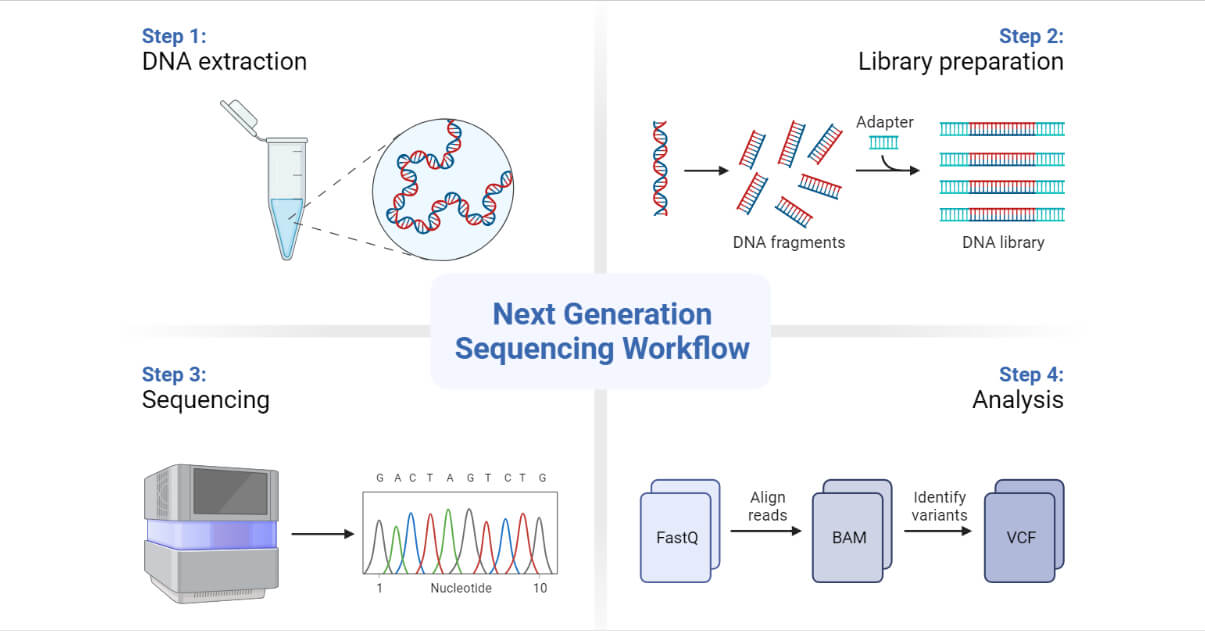
The workflow from extracting DNA or RNA from tissue or blood to converting it into files that can be analysed.
Summary
Section titled “Summary”Cancer is a state in which changes in several control circuits accumulate and clones carrying different changes coexist. DNA, RNA, and proteins reveal stored changes, current usage, and actual functional products respectively.
The next lesson, Choosing Which Biological Data to Produce, selects measurement scope and resolution to match the question and budget.
Footnotes
Section titled “Footnotes”-
Omics is a collective term for fields that comprehensively study a complete set, such as the genome, transcriptome, or proteome. ↩
-
NGS (next-generation sequencing) is a collective term for sequencing technologies that read millions to billions of DNA or RNA fragments in parallel. ↩
-
FASTQ is a raw output file format that stores the sequence of each read together with a quality score for every base. ↩