01. DNA, RNA, and Proteins
Biological data answers different questions depending on the layer being observed.
- DNA: what changed in the blueprint?
- RNA: which parts of the blueprint are being used, and how much?
- Protein: what was actually made and put to work as a result?
Once you understand the difference among these questions, you can understand what kind of data names such as WGS, RNA-seq, and proteomics produce. This lesson focuses only on the flow from information stored in DNA through RNA to protein.
From a developer’s perspective, these are different observation layers of one system.
| Observation layer | Question in a software system | Biological data |
|---|---|---|
| Stored definition | What is recorded in source and configuration? | DNA sequence |
| Current usage state | Which modules are being used, and how much? | RNA expression |
| Actual runtime product | Which components were made and put to work? | Protein amount and state |
The layers are connected, but they are not the same data. Source code being present does not mean a process is running, and abundant logs do not reveal a function’s return value. In the same way, DNA, RNA, and protein cannot substitute for one another.
1. DNA: the original copy that stores all information
Section titled “1. DNA: the original copy that stores all information”Skin cells and liver cells differ in shape and role, but they carry almost the same complete copy of DNA. The difference does not come from the original copy, but from which parts of it they use.
In a development-project analogy, DNA is like the entire source repository. The repository contains not only executable code but also configuration, files excluded from the build, and repeated data.
Now we can name each scope.
- DNA (deoxyribonucleic acid): a long molecule that stores information as a sequence of the four letters A, T, G, and C.
- Gene: a region of DNA used to make a particular RNA or protein.
- Genome: all DNA, including genes and all remaining regions.
- Chromosome: a unit in which long DNA molecules are folded and bundled for storage inside a cell.
One human cell contains 23 pairs of chromosomes, 46 in total. If those chromosomes were unfolded into letters, they would form approximately 3.2 billion pairs of A, T, G, and C. About 19,000 genes make proteins; most DNA lies in regions that do not directly make proteins.
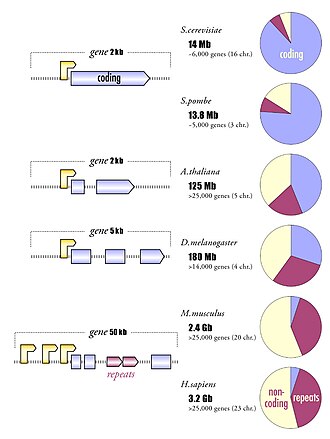
Gene structure and the proportions of coding and non-coding1 regions in the genome differ among organisms.
Before a gene is a region that controls when it will be used. When regulatory proteins bind there, the gene begins to be read. This switch-like region of DNA is called a promoter.
DNA that does not directly make proteins is not simply empty space. Some regions regulate gene use or maintain chromosome structure, while others contain the same sequence repeated many times. Changes in these regions can also affect disease or chromosome structure.
The field that studies the whole of DNA at once is called genomics.
2. RNA: a working copy of information currently in use
Section titled “2. RNA: a working copy of information currently in use”The insulin gene is highly active in pancreatic cells. The same gene is used very little in the brain or skin. Cells have nearly identical DNA, but they differ in how many working copies they make of the genes they need.
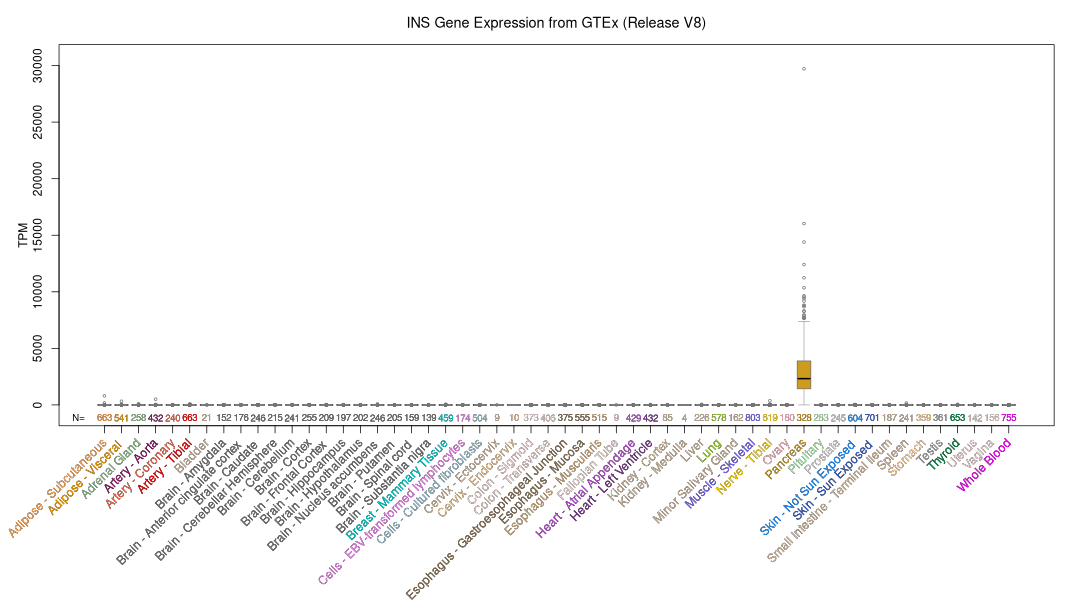
The insulin gene is expressed at a median of approximately 2,335 TPM in the pancreas and is barely expressed in other tissues.
This working copy is RNA. The process of copying a needed region from the DNA original into RNA is called transcription. It resembles creating a working copy of only what is needed now instead of delivering the entire original repository every time.
RNA is made from the four letters A, U, G, and C. Unlike DNA, it is usually single-stranded and uses U instead of T.
The working copy that carries instructions for protein production is mRNA (messenger RNA). DNA remains inside the nucleus, while mRNA leaves the nucleus and is used to make protein. rRNA and tRNA participate in protein production, while RNAs such as miRNA and lncRNA regulate how much other genes are used.
The pre-mRNA first copied from DNA contains both exons, the regions to retain, and introns, the regions to remove. The process of removing introns and joining exons is called splicing. The completed mRNA is used to make protein.
All RNA present in a cell or tissue at a particular time is called the transcriptome. Measuring the transcriptome tells you, “Which genes is this cell using now, and how much?”
3. Protein: the function that actually runs
Section titled “3. Protein: the function that actually runs”Making a large amount of mRNA from the insulin gene is not the end. The cell reads the mRNA information, joins amino acids, and folds the chain into a particular three-dimensional shape to make insulin protein. The insulin must then be secreted to regulate blood glucose.
The process of converting RNA information into protein is called translation. A group of three bases in mRNA, called a codon, specifies one amino acid.
A protein is a molecule made when an amino-acid chain folds. Enzymes carry out chemical reactions, receptors receive external signals, and structural proteins support a cell’s shape. Proteins perform the cell’s actual functions.
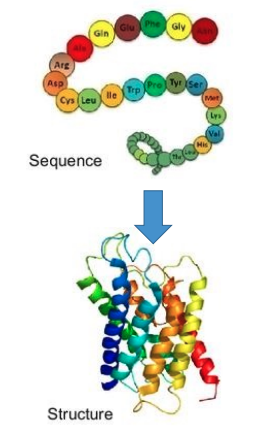
The order of amino acids and the folded shape determine a protein’s function.
All proteins present in a cell or tissue at a particular time are called the proteome. The proteome is measured mainly by mass spectrometry. Unlike DNA and RNA sequencing, its raw data is a mass spectrum.
4. DNA, RNA, and proteins form one flow
Section titled “4. DNA, RNA, and proteins form one flow”The relationship among the three data types fits into one line.
Store information in DNA → copy the needed part into RNA → read RNA to make protein
This flow of information is called the central dogma.
Written as type transformations, the minimal model looks like this. Real cells contain many more regulatory and degradation steps, but this model makes clear what is converted into what.
dna_copy = replicate(dna)rna = transcribe(select_region(dna))mature_rna = splice(rna)protein = translate(mature_rna)select_region() and the rate of every step are not fixed. They change with the signals and state of the cell, while RNA and proteins are continually degraded. The central dogma is therefore not a build script that runs once and stops, but an information flow repeated concurrently throughout the cell.
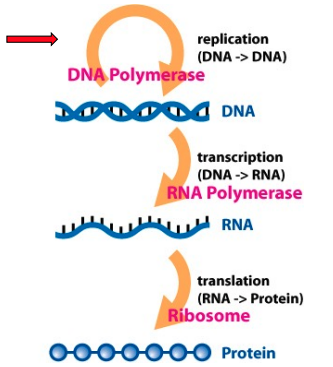
DNA makes a copy through replication and produces RNA through transcription; RNA becomes protein through translation.
- Replication: the cell makes a complete copy of DNA before it divides.
- Transcription: a needed DNA region is copied into RNA.
- Translation: mRNA information is read to make protein.
You can watch the process in motion in the following video. It has English audio and Korean subtitles and lasts approximately two minutes.
Even for the same gene, the question changes by data layer. DNA asks whether its sequence changed, RNA asks how much it is used, and protein asks about the amount and state of the actual product.
You can connect all three layers in one candidate decision in the Rosie neoantigen PoC, from variant to peptide candidate. Its synthetic data shows how a DNA variant, RNA expression, and protein sequence answer different questions.
Summary
Section titled “Summary”The three data types are connected, but they answer different questions.
DNA = what changed · RNA = what is being used, and how much · Protein = what was actually made
The next lesson, Cancer Cells and Omics Data, explains why these three measurement layers are used to observe changes in cancer cells.
Sources
Section titled “Sources”- Scale of GTEx v8, 948 donors and 17,382 samples: UCSC GTEx Gene V8 · GTEx Portal
- Number of protein-coding genes: The status of the human gene catalogue (2023)
Footnotes
Section titled “Footnotes”-
Coding/non-coding: here, “coding” does not refer to programming. It means whether a region contains information for making a protein. The parts of DNA that contain protein-design information and are actually translated into proteins are coding regions, mainly exons; all remaining regions that do not make proteins are non-coding regions. Most of the human genome is non-coding. Once considered “useless,” many such regions are now known to have functions including regulation of expression. ↩